
- Home
- VST Plugins
- Neural DSP Parallax X
- Version
- 1.0.0
- Developer
- Neural DSP Technologies
- Languages
- English
- License type
- K'ed by FLARE
| macOS range | macOS 10.15 or later |
|---|---|
| Chip | Apple Silicon, Intel 64-bit |
| Download | 179 MB |
Screenshots
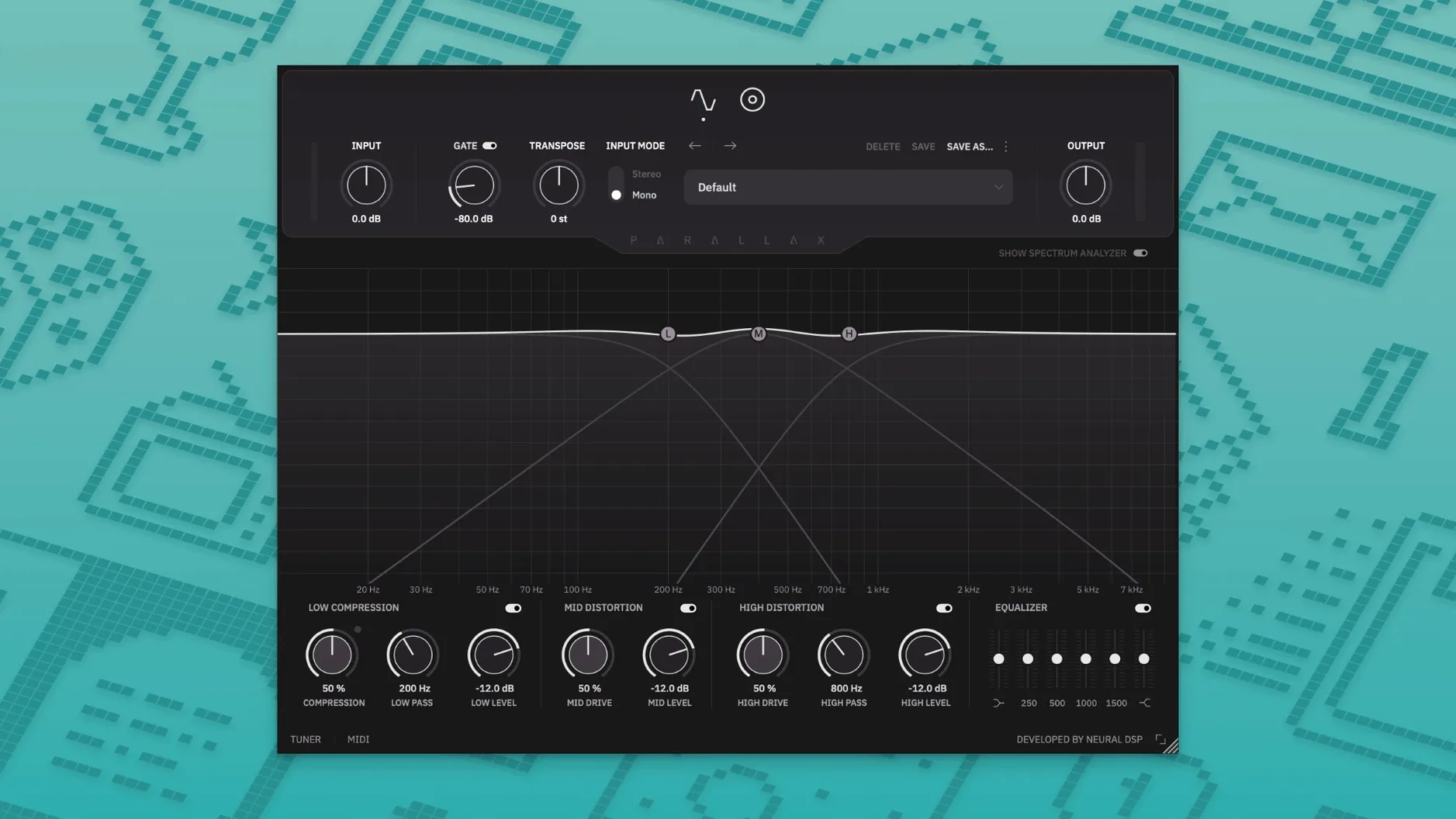
The Transpose control sits right on the main panel, and that is where Parallax X starts to feel different from the original. You can drop the whole signal an octave or shift it up, which changes how the distortion reacts before it even hits the band split. Inside, the plugin processes low, mid, and high frequencies separately, then mixes them back together. The low band has a compressor built specifically for bass, so the bottom stays tight while the mids get distortion for note articulation and the treble adds fuzz and edge. A six-band graphic EQ shapes the blend before it hits the cabinet emulation, which offers six virtual microphones.
- Parallel multiband distortion with separate low, mid, and high controls
- Low-frequency compressor designed for bass
- Six-band graphic equalizer for fine-tuning the mix
- Cabinet emulation with six virtual microphones
- Built-in tuner and metronome with time signature, accent, and note-length settings
- Standalone mode for practice without a DAW
Legacy Parallax presets import into the Parallax X user folder during setup, and the installer keeps the original version intact. For a bass track that needs to cut through without losing its low end, this is the tool.
How Parallax X Compares With Other Bass Plugins
Neural DSP Parallax X fills a specific slot. Compared to something like IK Multimedia Ampeg SVX, the approach is inverted. SVX models a specific amp and cabinet, so you dial in a sound by tweaking amp controls and mic positions. Parallax X does not try to be an amp. It treats the bass as three separate signals, distorts each one differently, and reassembles them. You get a processed sound that still keeps the original low-end character because the low band is compressed, not distorted.
Against Universal Audio's Precision Enhancer, Parallax X gives you more direct control. Precision Enhancer works as a harmonic exciter with a sub-harmonic generator, good for adding sheen or a sub-octave. Parallax X lets you set distortion per band, adjust crossover points, and use a full graphic EQ. If you need to shape the attack of a picked bass part or add grind to the mids without losing the palm-mute thump, Parallax X covers that in one instance.
Neural's own Parallax (the original) is still the simpler option. Parallax X adds Transpose, a live tuner, and a metronome. If you only need the core distortion blend, the original works fine. If you want pitch shifting and a standalone practice rig, Parallax X justifies the upgrade.
Hearing Presets Reveal Band Split and Distortion
Start with a clean DI bass track, no compression on the channel. Insert Parallax X, then toggle between its factory presets to hear how the band split and distortion interact. That gives you a feel for the range before you build your own patch.
- Set the low band compressor to clamp the sub frequencies. The ratio control on the compressor works well with a pick attack.
- Push the mid distortion just until you hear note separation. Too much and the articulation turns into buzz. Back off until you feel it in the attack, not the sustain.
- Use the six-band EQ after the distortion to cut any mud around 200-300 Hz. The distortion can thicken that area, and the EQ cleans it up before the cabinet stage.
- Try the cabinet emulation with only one microphone at first. Start with the close mic position, then blend in a room mic if the track needs space.
- In standalone mode, enable the metronome and set a slow tempo to work on timing without a DAW. The tuner stays visible, so you can check intonation between takes.
If you search for a neural dsp mac download, make sure the installer you get matches version 1.0.0 for macOS 11 or later. Both Intel and Apple Silicon are supported.
A Studio Engineer's Workflow
I handle mixing for a local rock band. The bassist uses a five-string with a lot of low B string rumble. Before Parallax X, I would split the bass into two tracks, compress the low end, and run the high end through a guitar amp sim. Now I insert one instance of Parallax X. The low band compressor catches the sub peaks, the mid distortion adds grit to the eighth notes, and the treble fuzz gives the slap sections a crack that cuts through the guitar. The Transpose control lets me shift the lowest notes up an octave when they get too boomy for the chorus. The whole bus stays phase-coherent because the plugin handles the split internally. It saves a bus and two aux tracks per session. That is a real time saver on a 40-song album project.
- Adds Transpose, Live Tuner, and Metronome features.
- New factory presets and a revamped interface.
- Redesigned Spectrum Analyzer.
- macOS 11 or later
- 64-bit
- Intel or Apple Silicon
The install order
- Open the downloaded disk image.
- Run the standard installation process.