- Home
- VST Plugins
- Tone Projects Michelangelo

- Version
- 1.0.4
- Developer
- Tone Projects
- Languages
- English
- License type
- k'ed by GUISEPPE
| macOS range | macOS 10.15 or later |
|---|---|
| Chip | Apple Silicon, Intel 64-bit |
| Download | 123 MB |
Screenshots
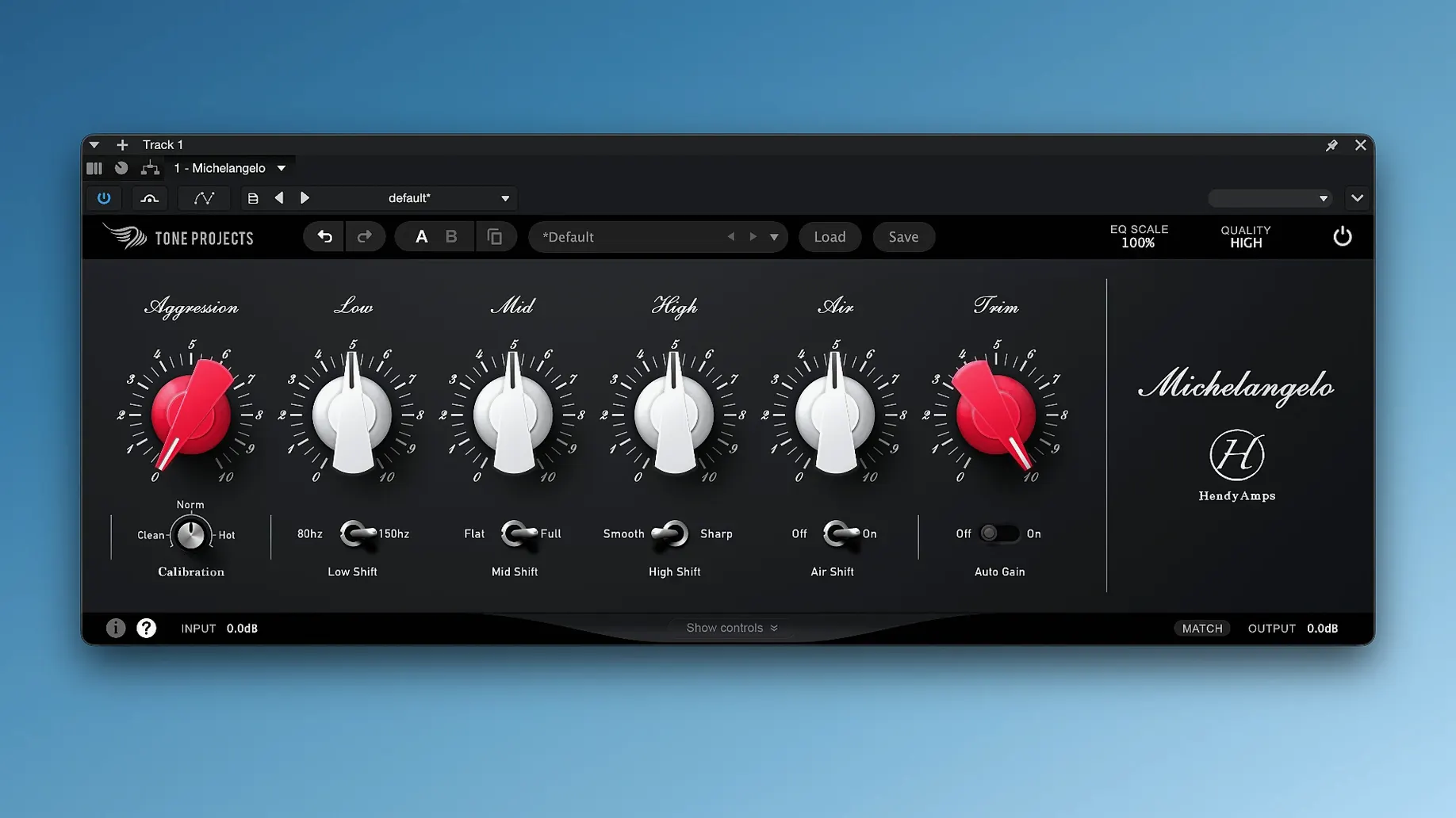
If your Mac runs macOS 10.15 Catalina or later, Tone Projects Michelangelo will run on it. The plugin supports both Apple Silicon and Intel architectures, so it works on the latest M-series Macs and older Intel models alike. No special workarounds needed for Rosetta; it runs natively on ARM.
Michelangelo is a stereo EQ and harmonics generator, modeled after the Hendyamps Michelangelo hardware unit. It shapes frequencies in a mix while adding analog-style warmth and saturation, inspired by vintage tube radio gear. Think of it as a tone shaper rather than a plain corrective EQ.
The interface is straightforward: set your frequency bands, adjust gain, and dial in the harmonic content to taste. It works well on individual tracks or the mix bus. The current version is 1.0.4, and the plugin interface is in English.
How a Post-Production Engineer Uses It
During a recent dialog-mixing session for a podcast, I had a vocal take that sounded clean but flat. The client wanted more body without messing up the intelligibility. A plain parametric EQ could fix the low-mids, but it would leave the voice sounding digital. That is where Michelangelo fit: I dialed in a gentle low-shelf boost around 150 Hz, let the extra harmonic band add a touch of saturation, and the voice sat in the mix without needing a separate saturator.
Cutting a snare ring on a stereo drum bus
I open the plugin on a stereo drum bus. I start by sweeping the four interactive bands to find a snare ring around 1.8 kHz, cut it by 2 dB. Then I switch one of the extra bands to wide bell mode and add 1.5 dB at 110 Hz for kick weight. The harmonic generation brings out a subtle tube warmth that glues the shells together. I solo the bus, adjust the harmonic mix until the cymbals soften slightly, and move on. The whole adjustment takes under a minute because the bands respond fast and the interface stays out of the way.
Sound Designer's Workflow: Shaping a Pad for a Film Scene
A colleague of mine was building a synth pad for a tense, slow-motion sequence in a short film. The raw patch from the soft synth was too clean, too digital for the mood. He wanted the pad to feel slightly worn, like it was coming through an old radio. He loaded Michelangelo on the track and started with a broad midrange cut around 400 Hz to take out some boxiness. Then he engaged the harmonic section, dialing in just enough to add a slight, warm distortion that made the sound feel compressed and aged. One of the extra bands, set to high shelf, added a touch of air at 10 kHz, but he kept it subtle. The final pad sat in the mix with a character that matched the dusty, analog look of the film's footage.
A Typical Session: Taming a Bright Acoustic Guitar
I start a session with a stereo acoustic guitar track that is too bright. The pick noise and string squeaks are distracting. I insert Michelangelo on the track. First, I use the four interactive bands: I set a gentle cut around 5 kHz to reduce the harshness, and a small boost at 120 Hz to bring back some low-end body from the mic placement. The track already sounds more balanced, but it still feels a bit sterile. I switch one of the extra bands to low shelf mode and add a slight lift at 80 Hz. Then I bring up the harmonic generation slowly until the guitar has a subtle, rounded warmth that smooths out the transients. The pick noise is still there, but it is no longer piercing. I do a quick A/B and the difference is clear: the raw track is thin and aggressive, the processed one is full and musical. I save the preset for similar sessions later.
In short, if you are on a supported Mac and want a characterful EQ that adds musical coloration, Michelangelo is worth a look.
- macOS 10.15 or later
- Apple Silicon or Intel processor
- Interface language: English
Questions I get about this line
Michelangelo requires macOS 10.15 or newer.
Yes, it supports both ARM (Apple Silicon) and x86 64-bit Intel architectures.
It is a stereo EQ and harmonics generator that shapes frequencies and adds tube-style saturation and warmth.
The install order
- Open the downloaded package and read the included installation and activation instructions.
- Follow the steps provided inside the package to install and activate the plugin.