Free download (41 MB) Previous versions
- Version
- 9.3
- Developer
- West-Forest-Systems
- Languages
- English, German, Spanish, Italian, Dutch, French, Swedish, Japanese
- License type
- Included
| macOS range | macOS 10.15 or later |
|---|---|
| Chip | Apple Silicon, Intel 64-bit |
| Download | 41 MB |
| Previous versions | 2 on file |
Screenshots
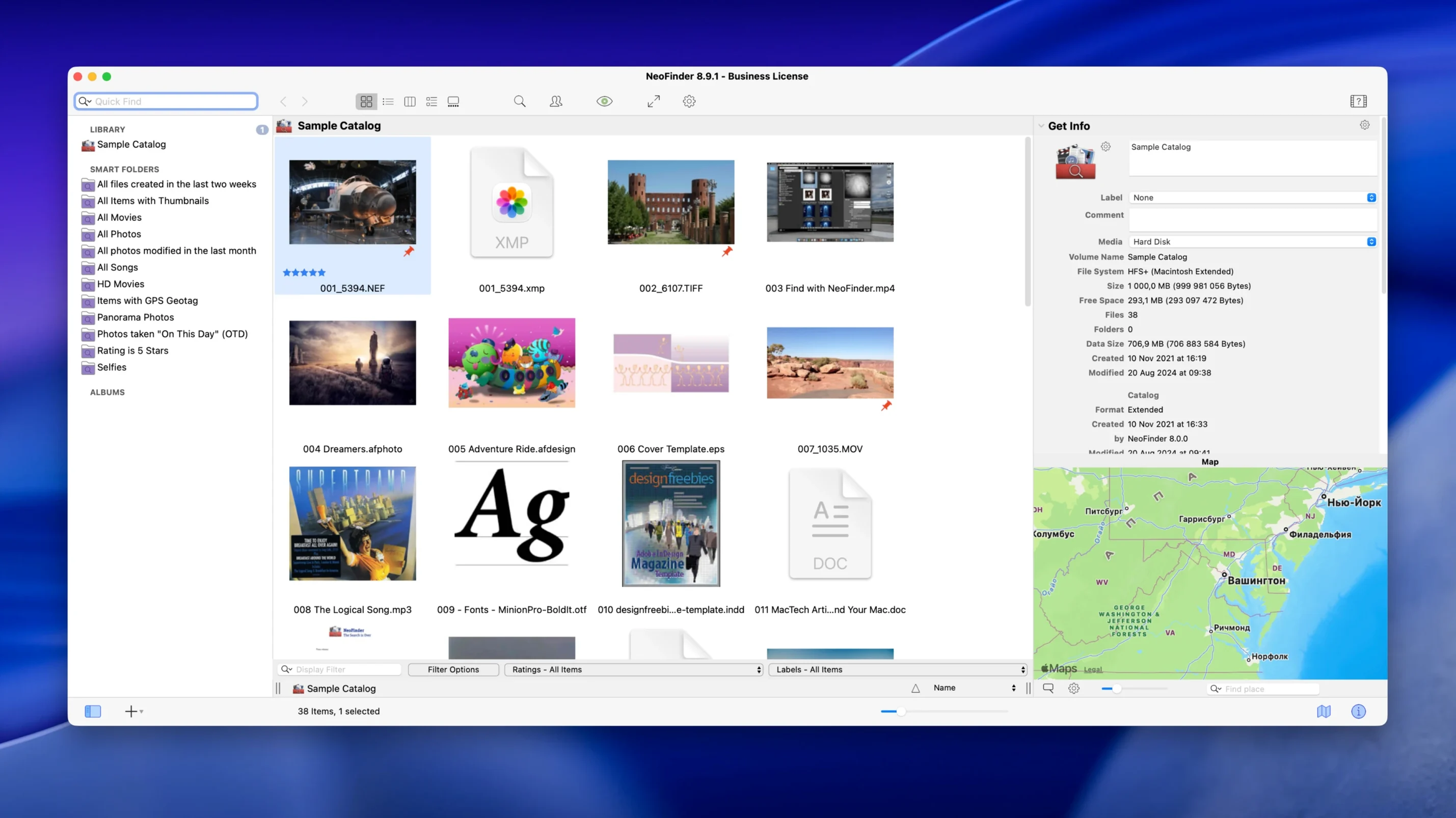
You have a stack of external drives, a mess of photos, and video files scattered across folders. NeoFinder builds a searchable database of everything — thumbnails, metadata, even checksums — so you can find what you need without plugging in each disk.
Does NeoFinder work on Apple Silicon Macs?
Yes. NeoFinder runs natively on both Intel and Apple Silicon Macs. You only need macOS 10.15 Catalina or later.
What metadata can NeoFinder read?
It reads IPTC, EXIF, Adobe XMP, and GPS geotags. It also pulls thumbnails and lets you add keywords, descriptions, ratings, and geotags to media files.
Cataloging drives before they fill up
The most frequent error I see is not cataloging drives before they fill up. It works, but it takes longer than doing it in smaller batches as you add files.
Another mistake: skipping the MD5 checksum generation on important media. You only need to generate checksums for files that matter — raw photos, finished video exports, master audio tracks. Turning it on for every system file wastes time and disk space.
Beginners also forget that NeoFinder catalogs offline drives. After you scan a disk and eject it, the catalog stays. You can still search filenames, tags, and metadata. The mistake is assuming you need the drive connected to search.
Scenario: A photographer organizing client shoots
A wedding photographer shoots six weddings a month. She keeps the current month on her internal SSD and archives older shoots on external drives labeled by year.
She catalogs each drive with NeoFinder as soon as an archive disk fills up. When a client calls six months later asking for a specific black-and-white portrait from their ceremony, she searches the catalog by keyword, finds the file, and knows exactly which drive and folder it sits in. No digging through boxes of hard drives, no guessing which disk holds that particular date.
The bookmark sharing feature in 9.3 lets her send a small bookmark file to her editor, so he can locate the same media on his own copy of the drive without exchanging the whole catalog database.
Mistakes beginners make with NeoFinder
The biggest one: not setting up a consistent naming scheme for catalogs before you start. You end up with catalogs called "Drive 1," "stuff," and "backup" — and six months later you have no idea which is which. Label them by volume name, date, and content type from day one.
People also skip the multi-line annotation field in 9.3. It's there for a reason. Drop in notes about where the files came from, who worked on them, or what project they belong to. That text becomes searchable later.
Another common miss: assuming NeoFinder only works with local disks. It catalogs network volumes and removable media too. If you work off a NAS or swap SD cards between cameras, catalog those as well. The database remembers everything after the volume is gone.
And I still see users who never touch the "find similar photos" feature in 9.3. They keep hunting duplicates by hand. Let the software do it.
Scenario: A video editor managing archived projects
A freelance video editor keeps a dozen external drives with past client projects — raw footage, proxies, audio stems, final exports. Each drive holds multiple jobs, and the folder names are inconsistent across years.
He catalogs every drive with NeoFinder, generates MD5 checksums for the master export files, and writes multi-line annotations describing the project scope and client. When a repeat client asks for a revised cut of a two-year-old commercial, he searches the catalog by client name, finds the correct project folder, and checks the checksum on the master file before opening it. The whole search takes under a minute. No plugging in five drives to find the right one.
It can generate and verify MD5 FileCheck checksums. That gives you a way to confirm files haven't changed since you cataloged them.
- Find similar photos.
- Ingest entire media folders.
- Add multi-line annotations.
- Add bookmarks for sharing.
- Fix bugs.
- macOS 10.15 or later
- Intel or Apple Silicon
Questions I get about this line
Yes. Version 9.3 added bookmarks for sharing, so you can point another NeoFinder user to specific files or folders in your catalog.
Yes. Version 9.3 introduced multi-line annotations, so you can add detailed notes to any cataloged item.
The install order
- Open the downloaded disk image.
- Drag the app into the Applications folder alias.
- After copying finishes, launch the app from Launchpad.