- Home
- VST Plugins
- MixWave Manuel Gardner Fernandes

- Version
- 1.0.0
- Developer
- MixWave
- Languages
- English
- License type
- K'ed by FLARE
| macOS range | macOS 10.15 or later |
|---|---|
| Chip | Apple Silicon, Intel 64-bit |
| Download | 238 MB |
Screenshots
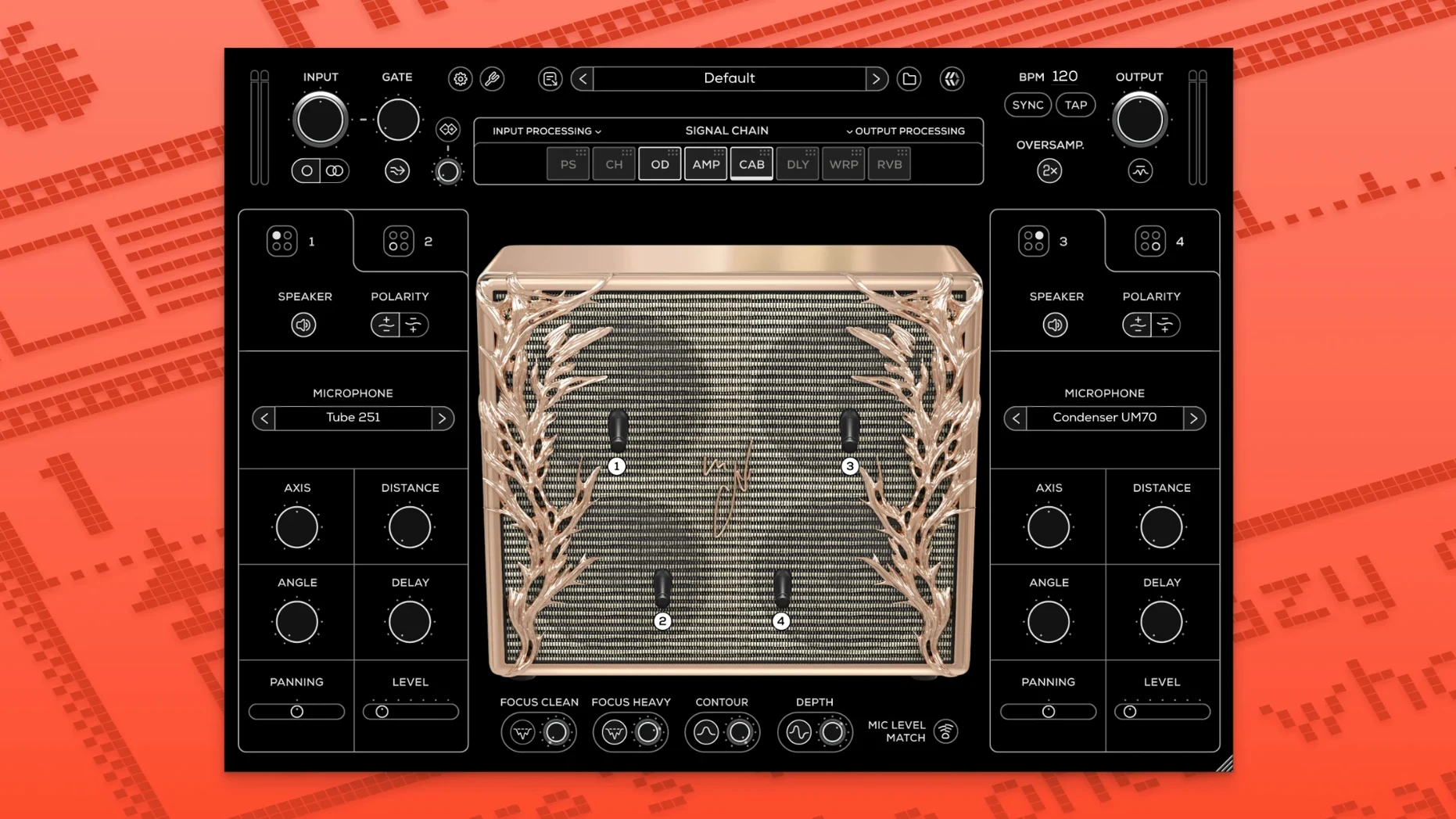
MixWave Manuel Gardner Fernandes is a guitar amp plugin that pairs a 4×12 cabinet module with a full effects rack and routing tools. The signal chain is fully reorderable, so you can place effects before or after the amp section to match your workflow.
- Available as VST3, AU, AAX, and a standalone app — 64-bit only.
- Runs on macOS 10.13 through macOS 15 on both Intel and Apple Silicon Macs.
- Cabinet module gives you microphone position, pan, and level controls.
- Focus Clean and Focus Heavy tools shape the core tone; a Contour control handles final EQ.
- Effects include overdrive, chorus, pitch shift, Warp, delay, and reverb.
- Interface language is English; an iLok License Manager account is required.
Set up a single SM57 mic in the cabinet module
Start by loading the standalone app or inserting the plugin on a guitar track. Open the cabinet module first and set up a single microphone — a Shure SM57 close to the cone center is a reliable starting point. Move it around while playing to hear how position changes the tone before adding more mics.
Try the transpose function early. It shifts the incoming signal without affecting the effects chain, so you can play in standard tuning while the plugin handles the rest. That saves time when you are working with multiple tunings in one session.
Focus Clean and Focus Heavy are worth testing on the same riff. Focus Clean tightens the low end without thinning it. Focus Heavy adds saturation and compression together. Switch between them to hear how the plugin adapts to different playing styles.
Automate presets with MIDI and practice in standalone mode
In a DAW, insert the AU version on a guitar track. The plugin responds to MIDI program changes, so you can automate preset switching from your controller. The standalone mode works well for practice — route your audio interface directly and use it without opening a full project.
macOS Audio MIDI Setup handles multiple outputs cleanly. You can send the plugin output to headphones while recording a dry signal into your DAW. The 4×12 cabinet module uses impulse responses, and macOS 10.13 or later handles those files normally — no extra configuration needed.
The VST3 version integrates with Logic Pro, Cubase, and other VST3 hosts on both Intel and Apple Silicon Macs. The AAX version works in Pro Tools. All formats share the same preset files, so you can move between them without redoing settings.
What version 1.0.0 brings to everyday use
- Initial release — the plugin ships with the full effects rack, cabinet module, and routing tools from day one.
- All effects (overdrive, chorus, pitch shift, Warp, delay, reverb) are included in the same window, so you do not need separate instances for each effect.
- Cabinet module supports up to four microphones simultaneously, each with adjustable position, pan, and level — useful for blending close and room sounds.
- Transpose function and built-in tuner mean you can stay inside the plugin for tuning and pitch needs, keeping your DAW track count low.
- Depth control adjusts low-frequency shaping, which helps when you switch from a single-coil to a humbucker guitar mid-session.
If you want a flexible amp rig that covers both clean and heavy sounds, this plugin packs the essentials into one window.
- Initial release.
- macOS 10.13 or later
- Intel or Apple Silicon
- iLok License Manager account required
Questions I get about this line
It is available in VST3, AU, AAX, and standalone formats, all 64-bit.
Yes, the signal chain allows modules to be reordered to suit your setup.
The install order
- Open the downloaded disk image.
- Run the standard installation process.