- Home
- VST Plugins
- Synapse Audio The Legend HZ v2.0.2.R1
Free download (472 MB) Previous versions
- Version
- 2.1
- Developer
- Synapse Audio
- Languages
- English
- License type
- k'ed by GUISEPPE
| macOS range | macOS 10.14 or later |
|---|---|
| Chip | Apple Silicon, Intel 64-bit |
| Download | 472 MB |
| Previous versions | 1 on file |
Screenshots
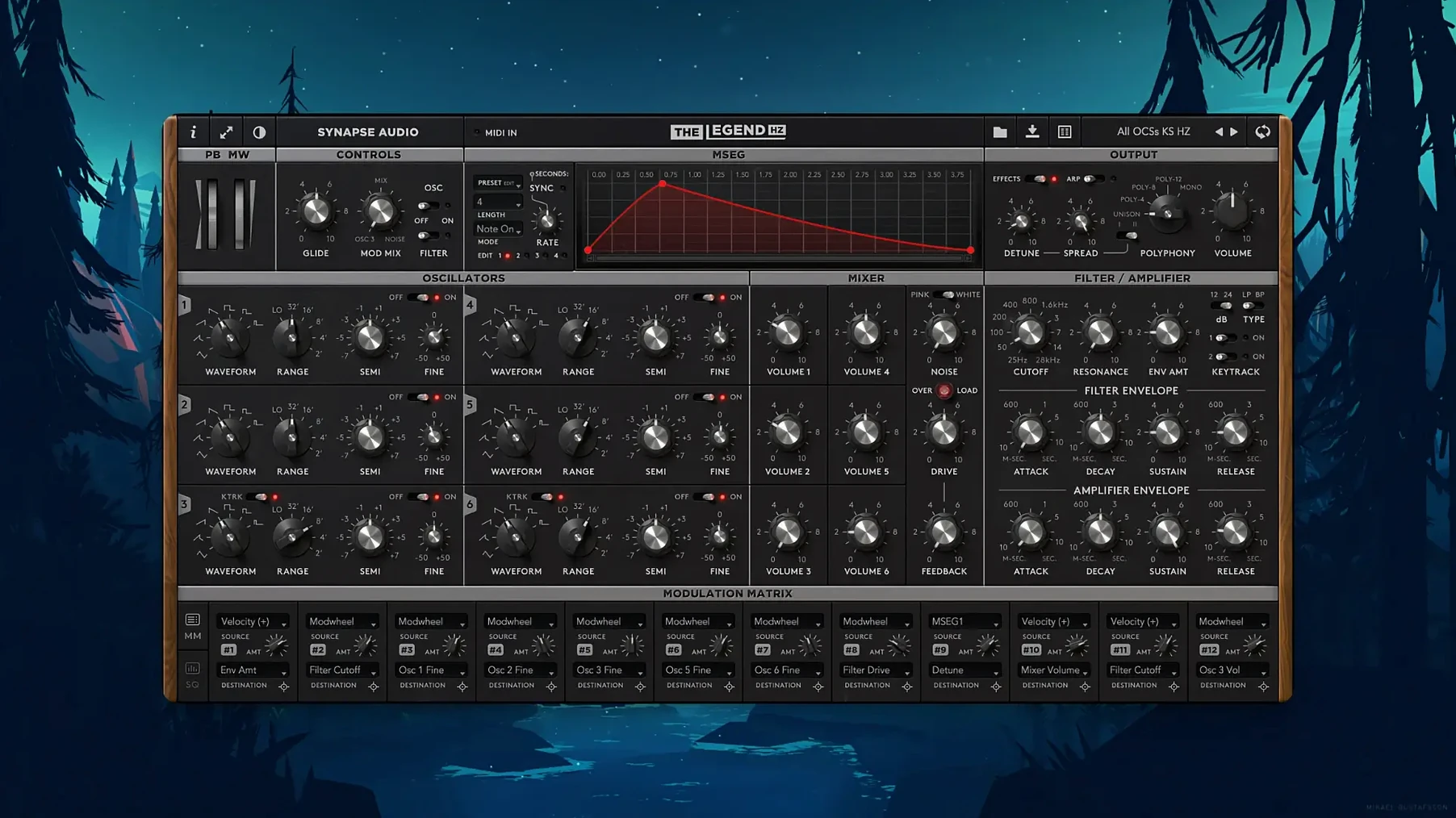
The Legend HZ runs on any Mac from macOS 10.14 onward, and it is fully native on both Apple Silicon and Intel 64-bit systems. That covers every Mac in a modern dental-clinic IT fleet, and every studio Mac too.
Minimoog-Style Analog with Up to 12 Voices
- Adding a Minimoog-style analog sound to your mixes.
- Playing up to 12 voices of polyphony — thicker than the original hardware.
- Creating movement with the built-in arpeggiator/sequencer.
- Using MPE controllers for expressive, per-note pitch and timbre.
- Loading existing The Legend patches — your old sounds work here.
VST, AU, AAX Compatibility and Six-Oscillator Tone
- Available as VST, Audio Unit, and AAX — fits Logic, Pro Tools, Cubase, and most Mac DAWs.
- Six VA oscillators plus a 914 Fixed Filter Bank give it a hefty tone.
- Unison mode thickens the sound without extra voices.
- Version 2.1 adds MTS-ESP microtuning support and a paragraphic EQ on the back panel.
- Interface is English only.
Working with the arpeggiator/sequencer for a bass line
Here is a straightforward workflow to build a sequenced bass patch from scratch. Start by initializing a preset. Select one of the six VA oscillators and dial in a sawtooth wave, then tune the second oscillator a fifth up for thickness. Route both through the 914 Fixed Filter Bank and set the filter to a low-pass mode with moderate resonance.
Enable the built-in arpeggiator and set the pattern to a 16-step sequence. Input a root-note pattern with occasional octave jumps on steps 5 and 13 — this creates movement without extra automation. Turn on unison mode and set the voice count to 4 for a wider stereo image. Save the patch as a user preset.
Map an MPE controller to the filter cutoff and release time. This lets you open the filter per-note during playback, which keeps the sequence from sounding static. The 200 factory presets by Hans Zimmer and Kevin Schroeder can serve as starting points for this kind of patch — tweak the arpeggiator pattern and save your own.
How It Differs from Other Minimoog-Style Synths
The Legend HZ sits alongside other Minimoog-style software synths on Mac. Here is how it differs from two common alternatives.
vs. Arturia Mini V
The Mini V emulates a single Minimoog Model D. The Legend HZ gives you six oscillators instead of three, plus the 914 Fixed Filter Bank that the original never had. If you need polyphony beyond the Mini V's monophonic limit, The Legend HZ delivers up to 12 voices.
vs. u-he Diva
Diva models multiple analog synths, including a Minimoog-inspired circuit. It is a multi-engine tool. The Legend HZ focuses on a single instrument with Hans Zimmer's specific mods — the filter bank, the compressor saturation in version 2.1, and MTS-ESP microtuning. If your work needs the Zimmer signature sound and patch compatibility with The Legend, The Legend HZ is the direct upgrade path.
Back-Panel Paragraphic EQ and Compressor Saturation
- The paragraphic equalizer on the back panel lets you shape the overall tone without reaching for a separate EQ plugin. Adjust five bands to tame harsh highs or boost low-end weight.
- Compressor saturation thickens the output stage. Engage it for subtle warmth or heavier crunch on bass lines.
- MTS-ESP microtuning support lets you load custom scales. If you work with alternative tuning systems, this saves exporting MIDI pitch bends.
- 50 new factory presets by Kevin Schroeder expand the library. These cover updated leads, pads, and sequenced patterns.
The Legend HZ v2.1 remains patch-compatible with the original The Legend. Projects that load the older instrument open it as before, so you can run both in parallel during a session.
- Added a paragraphic equalizer on the back panel.
- Added compressor saturation.
- Added MTS-ESP microtuning support.
- Added 50 factory presets by Kevin Schroeder.
- macOS 10.14 or later
- Apple Silicon or Intel 64-bit
- VST, Audio Unit, or AAX host
Questions I get about this line
Yes, it runs natively on Apple Silicon and Intel 64-bit Macs, with macOS 10.14 or later.
Yes, it ships as an Audio Unit plugin, so it works in Logic and any other AU-compatible DAW.
The install order
- Follow the installation instructions included with the download.
- Follow the activation instructions included with the download.